Modern Teaching at Universities

Managing teaching at a university involves a complex set of processes. At Sages, we deliver and integrate key solutions such as the USOS Student Information System, the UniPlaner scheduling tool, and academic chatbots. Together, they support teaching at every stage, from designing degree programs and building schedules to automating administrative services. This integrated approach helps universities create a more efficient, student-friendly, and future-ready teaching environment.

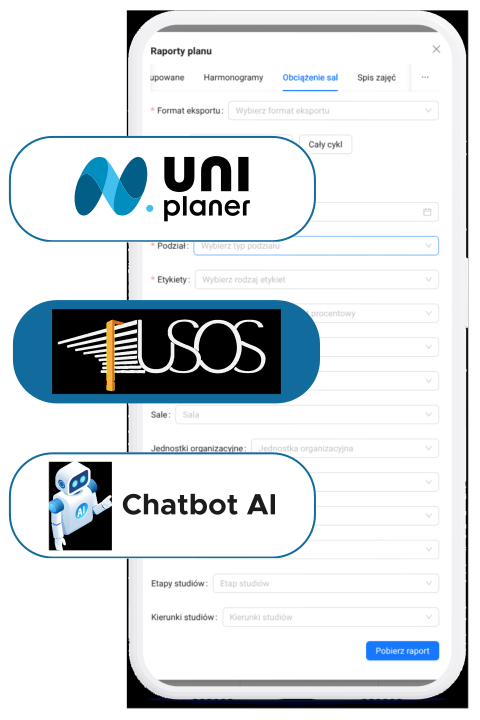
Illustration of integrated teaching solutions for universities

Integrated educational ecosystem

These three solutions collectively support planning, academic administration, and communication with students and applicants.

USOS – Center for Academic and Student Management

USOS (University Study-Oriented System) is an integrated IT environment designed for the comprehensive management of the teaching process.

  • Defining and managing degree programs, courses, class sections, and faculty workloads.

  • Management of coursework, grades, transcripts, and course completion.

  • Recruitment processes and candidate registration (IRK).

  • Scholarship system and financial aid.

  • Archiving and Analysis of Theses (APD).

  • Integration with central systems (POL-on, GUS).

  • Report and analysis generation (BIRT).

  • Full integration with e-learning platforms and university libraries.

USOS is built on a single database and a shared authentication mechanism (CAS), ensuring data consistency and security. It gives administrators and faculty an efficient way to manage teaching processes, while students can access key university services in one place through USOSweb.

UniPlaner – Smart Class Scheduling

The process of scheduling classes at a large university requires taking into account many variables: the number of sections, instructor availability, classroom capacity, academic terms, and logistical constraints on campus.

  • Automatic generation of class schedules using an optimization algorithm.

  • Resolving scheduling conflicts involving instructors, student groups, and classrooms.

  • Taking into account instructors' preferences, classroom availability, holidays, and internships.

  • Course scheduling for full-time, part-time, graduate, and doctoral programs.

  • Reporting on instructor workload and infrastructure utilization.

  • Exporting schedules to USOS and publishing them on USOSweb.

  • Automatic notifications about schedule changes.

UniPlaner not only speeds up the work of scheduling teams, but also improves the quality of course timetables. Thanks to its integration with USOS, it keeps timetable information consistent across the university ecosystem. The system also supports accessibility and equity in education by making it easier to assign classrooms and course groups that meet the needs of people with disabilities.

Academic chatbot for students and applicants

The integrated teaching environment is complemented by a university chatbot powered by artificial intelligence and natural language processing.

  • Answering questions about admissions, academic programs, and admission score requirements.

  • Assistance with filling out applications, downloading forms, and submitting applications.

  • Information about dates, exams, and schedule changes.

  • Integration with USOS and IRK – access to up-to-date course information.

  • Support for university regulations and documents in PDF and DOC formats.

  • Integration with messaging apps, such as Microsoft Teams and WhatsApp.

  • Multilingual and voice-enabled versions.

The chatbot is fully adapted to the nuances of the Polish language and uses modern semantic models. Thanks to its integration with USOS and IRK, it can dynamically retrieve information on degree programs, classes, and student statuses, providing instant answers to common questions. It also delivers tangible value to administrative teams by automating inquiry handling, reducing workload, and improving the student experience.

Key benefits for universities:

1. Organizational effectiveness

Integrated solutions streamline day-to-day operations and reduce manual work across teaching-related processes.

  • Process automation with less manual work in student services, scheduling, and inquiry handling.

  • Fewer errors thanks to entering data once and reusing it across integrated systems.

  • Respond more quickly to changes in schedules, recruitment, or semester planning.

  • Smooth collaboration between academic departments, administration, and IT.

2. High-quality teaching

The university gains greater control over schedules, program implementation, and resource allocation.

  • Clear class schedules and more effective use of personnel and infrastructure resources.

  • Adjusting class schedules to accommodate instructors' availability and students' needs.

  • Easier monitoring of program implementation and teachers' workloads.

  • Eliminating conflicts and overlapping classes in schedules.

3. A better experience for students and instructors

A shared platform for academic services simplifies access to information and improves communication with the university.

  • Full access to information about classes, grades, exams, and documents all in one place (USOSweb).

  • Automatic notifications and reminders about changes to the schedule or exam dates.

  • 24/7 contact with the university via chatbot.

  • A more consistent and predictable student experience.

4. Strategic and analytical support

Data from these systems supports both day-to-day instructional management and long-term development decisions.

  • Access to reports on staff workload, classroom usage, student enrollment, and enrollment trends.

  • The ability to analyze teaching effectiveness and plan future teaching cycles.

  • Better preparation for accreditation and reporting to the Ministry of Science and Higher Education and the Polish Accreditation Committee.

  • Data to support strategic decisions regarding the development of academic programs and the optimization of resources.

5. Accessibility and openness

The learning ecosystem is designed with broad accessibility and user convenience in mind.

  • Full compliance with WCAG requirements – accessibility for people with disabilities.

  • The ability to communicate in multiple languages and via voice.

  • Modern, user-friendly interfaces.

An integrated educational ecosystem helps universities bring together technology, people, and processes to create an environment that supports collaboration, quality, and innovation in teaching. It streamlines the day-to-day organization of classes while also strengthening the university's competitiveness and reputation in line with global trends in the digital transformation of education.

Let’s talk about a solution for teaching

Leave your contact information and we’ll show you how an integrated educational ecosystem can support your institution.

Consents (optional)

The controller of your personal data is Sages sp. z o.o., with its registered office in Warsaw. We process the data you provide in the form for the purposes of performing or concluding a contract, billing, accounting, and financial reporting; complying with other legal obligations; for the purposes specified in the consents; to establish, pursue, and defend claims; and for statistical purposes. You have the right to access your personal data, to have it corrected, deleted, or its processing restricted, to have it transferred, to object to its processing, to file a complaint with the President of the Personal Data Protection Office, and to withdraw your consent. For more information, please visit Privacy Policy .