Research activity evaluation is a key part of university development management. It assesses the quality and effectiveness of research in specific disciplines, shaping institutional prestige, research categories, and access to funding opportunities. Today, evaluation is more than a set of indicators. It is a strategic tool that helps universities understand their research potential, identify strengths, and support future development.
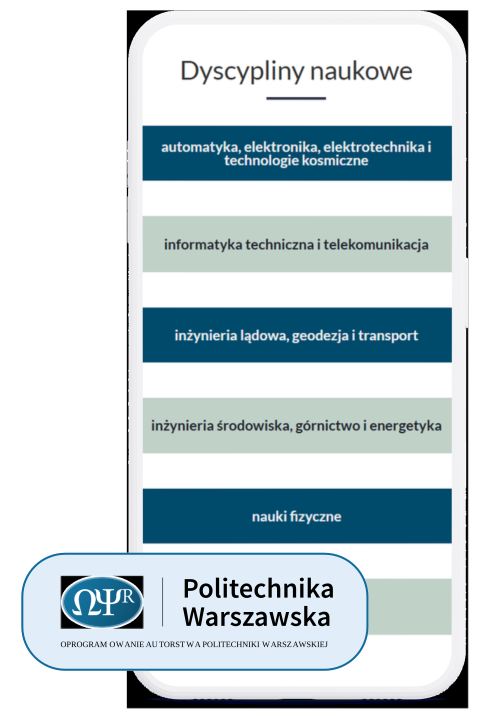
The purpose of the evaluation is to objectively assess the quality of research activities, and its outcome is the assignment of a research category (A+, A, B+, B, or C) to academic disciplines. This assessment is based on three main criteria:
As measured, for example, by journal rankings, citation counts, and bibliometric indicators.
This includes participation in research projects, grants obtained, implementations, patents, and the commercialization of research results.
This refers to the dissemination of research, participation in public discourse, collaboration with the broader socio-economic community, and the visibility of research outputs in the public sphere.
By analyzing these factors, the university can better plan the development of its academic disciplines, monitor progress, and implement measures to improve the quality and visibility of its research.
Data quality and consistency across systems are of paramount importance in the evaluation process. The Omega-PSIR system is a comprehensive CRIS (Current Research Information System) solution that combines the functions of a repository, a knowledge base, a reporting system, and an analytical tool to support the evaluation and planning of research development at the university. Developed at the Warsaw University of Technology and further refined by Sages, the system is currently in use at nearly 50 research institutions in Poland. Omega-PSIR has become the standard for managing research information, reporting to central systems, and preparing data for the evaluation of research activities.
Comprehensive record of academic achievements
The system collects publications, research data, projects, patents, and teaching and organizational achievements in a manner consistent with the data structure required by PBN and POL-on.
Automatic integration with domestic and international databases
Omega retrieves data from PBN, Scopus, Web of Science, Crossref, ORCID, and DataCite, eliminating the need to enter the same information multiple times.
Up-to-date evaluation indicators
The system automatically updates journal rankings, lists of publishers, and citation counts.
Simulations and estimates in scientific fields
The "Evaluation" module allows you to simulate results, calculate the fill rate of publication slots, and estimate the discipline category.
Reports and multidimensional analysis
The system allows you to generate reports for employees, teams, departments, and entire disciplines.
Flexible evaluation algorithms
The institution may define its own internal evaluation criteria.
Integration with university systems
Omega integrates with USOS, SAP, and other line-of-business systems.
In the context of evaluation, Omega-PSIR serves as a central repository of knowledge about the university’s research activities. Thanks to the use of CERIF and OAI-PMH standards, the data is structured, interoperable, and can be automatically transferred to external systems (e.g., POL-on, ORCID). The system enables comparative analyses across disciplines, departments, and research teams, while built-in visualization tools help understand the dynamics of research area development and the potential for interdisciplinary collaboration.
Omega-PSIR integrates with Altmetric Explorer for Institutions, which provides altmetric metrics—information on how a university’s research resonates in the public sphere. This makes it possible to combine traditional bibliometric evaluation with an analysis of social and media impact. Altmetric supplements Omega’s reports with data on research visibility, allowing for a more complete picture of the research output—not only its scientific value but also its social impact.
The integration of Omega-PSIR and Altmetric Explorer creates a comprehensive ecosystem for managing research information. Thanks to this, universities can thoroughly prepare for national discipline evaluations, generate reports and simulations of results, monitor the quality and impact of research in real time, and promote the achievements of researchers both domestically and internationally. Omega-PSIR, in combination with Altmetric, transforms the evaluation process into a tool for the university’s strategic development.
Leave your contact information, and we’ll show you how Omega-PSIR can support research information management and evaluation.