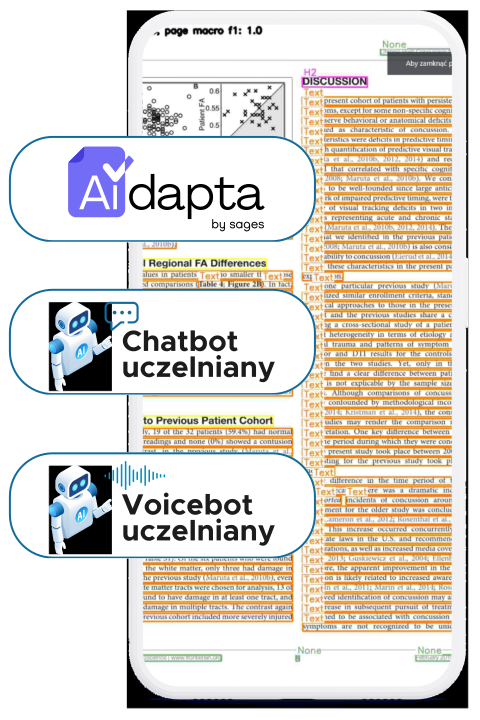
A modern university is not only about efficient teaching and administration. It is also about making information, documents, and services genuinely accessible to all users. Students, applicants, staff members, and people with specific accessibility needs expect fast, convenient, and equal access to content, regardless of format, device, or communication channel. That is why solutions that combine automatic document adaptation with modern support in text and voice channels are becoming increasingly important. This kind of ecosystem can be built with Aidapta, a university chatbot, and a voicebot that supports contact with the university.
Integrated accessibility and communication ecosystem
Three integrated solutions support both accessible content publishing and university communication across text and voice channels.
Aidapta – the university's document accessibility center
Aidapta helps automatically adapt digital documents to accessibility standards. In practice, this means universities can publish regulations, resolutions, forms, reports, information materials, and documents for students and staff faster and more efficiently while maintaining compliance with WCAG and PDF/UA requirements. The system combines automation, AI, and integration with repositories, CMSs, and other publishing systems, making accessibility part of the everyday document workflow rather than an additional manual step.
With Aidapta, universities can reduce time-consuming manual work, speed up content publishing, and make more materials available to users of assistive technologies such as screen readers and braille displays. It supports administrative and editorial teams as well as end users.
University chatbot – accessible communication 24/7
The document layer can be complemented by a university chatbot that provides quick access to information in natural language. This virtual assistant supports students, applicants, and staff in their day-to-day interactions with the university by answering questions about admissions, study organization, procedures, documents, and deadlines. It can operate around the clock, reducing the workload on administrative teams while improving the user experience and helping people find the right information faster.
In an academic environment, a chatbot does not replace staff. Instead, it takes over a large share of repetitive questions and straightforward information requests. As a result, the university can offer more accessible, predictable, and user-friendly contact with administration for applicants, current students, and staff alike.
University voicebot – a barrier-free voice support channel
A natural extension of accessible communication is a university voicebot, or voice assistant. This solution is particularly valuable when users prefer phone contact, need quick information without using forms or websites, or simply find voice channels more convenient and accessible. A voicebot can provide basic information, route callers to the right unit, answer frequently asked questions, and help the university handle large volumes of inquiries.
This component reflects the growing importance of voice-based communication and fits naturally within the Sages portfolio of conversational solutions, which includes voicebots.
Integrated accessibility ecosystem: benefits for the entire university
The combination of Aidapta, a chatbot, and a voicebot creates a cohesive digital accessibility ecosystem for the university. One solution focuses on document accessibility, another on text-based communication, and the third on convenient voice contact. Together, they support not only formal compliance with accessibility requirements, but above all a better real-world user experience, from applicants looking for admissions information to students using documents and forms to staff members who need quick access to procedures and university resources.
Organizational effectiveness
Automation of publication and inquiry handling reduces manual work, speeds up processes, and relieves administrative teams.
Greater compliance and lower risk
Accessible documents and well-organized publication processes help maintain compliance with digital accessibility requirements and clarify responsibility for content quality.
Better user experience
Students, applicants, and staff gain faster access to information, documents, and support in text, document, and voice formats.
Real inclusivity
Accessibility stops being an add-on and becomes an integral part of how the university communicates with its environment. People with disabilities, international users, and anyone who expects simple and fast contact with the institution all benefit.
A modern university brand
A university that invests in accessible documents and intelligent communication strengthens its image as a responsible, open, and modern institution.
With integrated solutions that support digital accessibility, universities can effectively combine technology, service quality, and social responsibility. This approach streamlines the daily work of administrative teams, brings more order to publishing processes, and improves the experience of everyone who uses university services.
Let’s talk about implementing solutions
Leave your contact information and we’ll show you how Aidapta, the chatbot, and the voicebot can support processes that improve communication and access to content.